
Bangkok is hosting the IMF-World Bank Annual Meetings from 12 to 18 October 2026, bringing the world's economic conversation to a city where service and care are part of everyday business. The official programme places Thailand at the centre of that gathering.
One opening-day discussion carries a message that matters well beyond finance. Reporting on the AI debate describes a challenge familiar to anyone running a clinic or hotel: how to use powerful tools without quietly handing over human judgement.
I have worked at the intersection of hospitality and preventive healthcare since 2006. My question is not whether AI belongs in these businesses, but whether we are clear about what it should support and what people must still own.
AI scales efficiency, but in healthcare and hospitality, trust is the product, and trust is built by people.
What the Bangkok conversation means for an owner
The scale of change is significant. In her earlier IMF analysis, Kristalina Georgieva explained that almost 40% of global employment is exposed to AI, with exposure reaching about 60% in advanced economies.
Exposure does not mean every affected job disappears. Some work becomes more productive; other tasks may be replaced, making skills, safeguards and the distribution of benefits important business questions.
At the Bangkok meetings, Tiffany Xingyu Wang brought the discussion back to judgement. The Nation's opening-day report describes her warning that AI can sound confident without being correct, while the people using it gradually stop questioning its answers.
That is an operational risk, not just a technology debate. A team needs the knowledge, authority and confidence to check a recommendation and refuse it when the context demands something different.
Ajay Banga also pointed towards practical applications. Reporting on his opening-day discussion identifies primary healthcare and tourism among sectors that can create sustainable employment, and describes nurses using simple AI tools to support assessment and connect patients with doctors.
My reading is straightforward: technology can strengthen people's ability to serve. It should not become an excuse to remove responsibility from the people delivering that service.
Healthcare and hospitality are different
A patient does not simply purchase an appointment. They place their body, concerns and sometimes their future in someone else's hands.
A guest gives a hotel their time, wellbeing and expectations. In a wellness destination, those expectations may include recovery, reassurance or help making a difficult change.
Both businesses must deliver competence, but competence alone is not the full experience. People also need to feel heard, safe and cared for.
AI can organise a record, personalise an itinerary or flag information for review. It can support clinical decision-making within appropriate safeguards, but that does not transfer clinical accountability away from qualified professionals.
Consider a patient who does not understand a recommendation, or a guest who says everything is fine while clearly feeling uncomfortable. A polished automated response may close the interaction without resolving the concern.
A person can pause, ask another question and take responsibility for what happens next. These are not soft extras added after the business model is built; they are part of what customers are trusting the business to provide.
This is why I do not measure AI adoption only by speed or the number of tasks removed. I also ask whether the patient or guest has become more confident in the people caring for them.
The Business Biohacking answer
My experience as the former CEO of VitalLife Corporation, the preventive wellness arm of Bumrungrad International Hospital, is part of the background I bring to this question. Bridging healthcare and hospitality requires attention to both credible care and the way people experience that care.
The same discipline informs AJT Wellity Asia's STRATIX and Business Biohacking approach. Start with the business architecture: who is being served, what the organisation promises, how the team delivers it and who remains accountable.
Then decide where technology belongs. Do not start with a tool and redesign the patient or guest around its limitations.
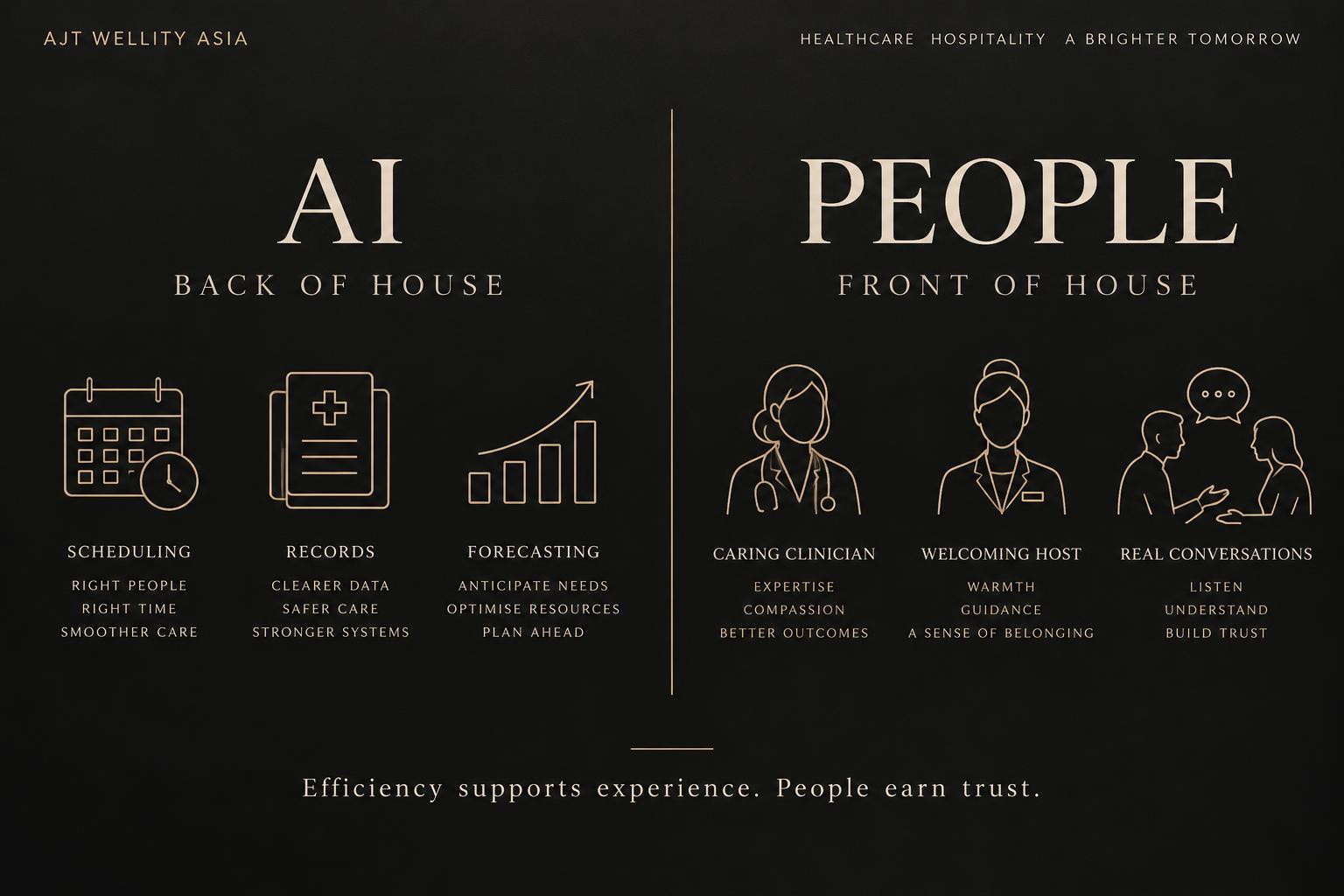
The model I favour is AI in the back of house, human experience in the front. Bookings, records, forecasting and administrative preparation can benefit from automation, provided privacy, accuracy and appropriate oversight are built in.
The purpose is to return time and attention to care, welcome and relationships. If automation saves ten minutes but the team simply receives more work, the experience may not improve at all.
1. Map where trust is won or lost
Walk through the journey from the first enquiry to the follow-up. Identify where someone may feel uncertain, where explanations matter and where a handover can leave them feeling forgotten.
Ask who owns each of those moments. A journey without clear ownership cannot be repaired by a faster booking system.
2. Automate support, not accountability
Begin with repeatable work that releases staff from unnecessary administration. Keep a clear human route for sensitive questions, unexpected circumstances and decisions that affect health or wellbeing.
Even an administrative task can touch trust when it involves private information or a missed appointment. The test is not whether a task sounds routine, but whether the safeguards match its consequences.
3. Train people to check and overrule AI
Staff need more than instructions for using a system. They need to understand its limits, recognise when an answer does not fit and know who to escalate to.
Make overriding a recommendation an accepted responsibility, not a sign that someone is resisting innovation. The quality of the model depends on the judgement of the people around it.
Faster is useful. Trusted is essential.
Bangkok is a fitting place for this conversation. For healthcare and hospitality owners here and across Asia, the opportunity is not to choose between technology and humanity, but to design how they work together.
Use AI to remove friction. Use the time it gives back to listen properly, explain clearly and follow through on what was promised.
AI will make us faster. Only people will make us trusted.
If you are building a hospital, clinic, resort or wellness destination, let's talk about where AI belongs in your business and where trust must stay human. Contact AJT Wellity Asia for a Business Biohacking conversation.